I Let AI Build My Entire Business Website
By Stephen Kearney
I’m not a web developer. I run an IT consulting business - I help other businesses automate their operations using Microsoft tools and AI. So when I decided to rebuild my own website from scratch in late April 2026, I had two options: pay a developer, or test Claude’s hand at making pretty website stuff.
I used Claude Code - an AI tool that writes and manages code - as the primary builder. Three weeks later, the site was live, showing up in Google, and doing everything the old Wix site did (and more). I spent roughly 15-20 hours of my own time across the whole project, while running my consulting practice in parallel.
Here’s what I actually learned.
AI is only as good as your instructions
The most common thing people say about AI coding tools: “I tried it and it just made a mess.” I believe them. But I’d argue the mess usually starts with the instructions, not the AI.
Before I wrote a single line of code, I spent time mapping out the project properly - what pages the site needed, what content would go where, how the old Wix URLs would redirect to the new ones, what the site should feel like visually. That planning took a few hours. It meant that when I started giving Claude Code instructions, I wasn’t figuring things out as I went - I was directing something I’d already thought through.
The analogy that fits best: it’s like briefing a contractor. A good contractor can build almost anything. But if your brief is vague, you’ll get a result that’s technically correct but not what you actually wanted. The brief is your job. The build is theirs.
Where I got this right, Claude Code was impressive. “The middle pricing tier should look like the obvious recommended choice” - it came back with a properly elevated card, a “Most Popular” badge, and the right visual contrast to make the other options feel secondary. I didn’t specify any of that detail. I just knew what outcome I wanted.
The marketing plan did the work the designer never had to
Before I touched Claude Code, I had a proper marketing plan document - not a vague “we want more leads” brief, but an actual document covering my ideal clients, what problems they’re trying to solve, how I want Secure Minded to be positioned in the market, and what tone the brand should carry. This was the result of work done with a Marketing Strategist.
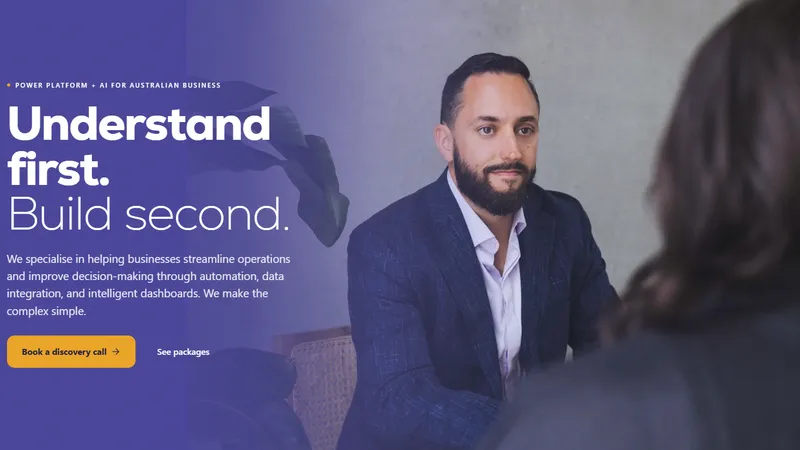
I fed that document to Claude Design when it was time to do the design. And what came back wasn’t a generic dark-coloured tech website. It was a site that reflected my business - the messaging, the service framing, the visual confidence. Dark and indigo, like I’d described. Copy that talked to the kind of business owner I’m actually trying to reach.
The best way I can describe it: it was like having my developer talk directly to my marketer, working from the same brief, at the same time. There was no translation layer. No “can you send the brand guidelines to the dev?” No waiting for someone to interpret what “confident but approachable” means in practice.
That only worked because the marketing document was solid. A vague brand brief would have produced a vague website. The document I’d built - positioning, audience, tone, differentiation gave the AI something real to work from. The design came out the other end genuinely on-brand, not just aesthetically acceptable.
The one decision that saved me a full day
Early in the build I made a choice I didn’t fully appreciate at the time, all the actual business content (pricing, team bios, service descriptions, testimonials) went into structured files that sat completely separately from the design.
On day two, I looked at the site and didn’t love it. The structure was right, the content was right, but visually it felt like a default. So I decided to give Claude Design a go. Fed it the info from the marketing doc, new colour palette, new fonts, new layout components.
83 changes in a single day. And every piece of content survived untouched, because none of it had been tangled up in the design. Claude Code rebuilt the look of every page without touching a single word of copy or a single price.
That separation “content lives here, design lives there” isn’t a technical concept. It’s just good organisation. And it paid for itself the moment I changed my mind about how the site should look.
Where things went wrong (and why)
Three real mistakes, all with the same root cause.
I built out the first version of my case studies and named real clients. I knew I had a policy about not naming clients publicly. I just didn’t write it down before I started. Claude Code wrote exactly what I asked for - detailed case studies with real company names. Eight rounds of edits to clean it up.
The visual redesign on day two cost me time I wouldn’t have lost if I’d sorted out the look and feel before building the pages. I got impatient. Built first, decided second.
The tracking setup looked perfect from the inside. I’d asked Claude Code to set up nine specific website tracking events - things like “someone clicked the contact button” or “someone downloaded the capability statement.” The code looked clean. Everything seemed to pass. Then I ran a live test in an actual browser and found three of the events were silently not working. They would have quietly failed for months with no error message to alert me.
The pattern across all three: Claude Code did exactly what I described. I described the wrong thing, or I didn’t describe it completely enough. That’s a different problem from “the AI made a mistake.” Once I understood that distinction, I became a better operator.
What this actually costs in time
The numbers that surprised me most:
- 3 weeks from blank page to live site
- 15-20 hours of my time total (not per week - total)
- 9 pages live, plus 10 blog posts and 4 case studies as individual pages
- Near-perfect mobile performance score on Google’s own testing tool (Lighthouse 97)
I was billing client hours the whole time. This wasn’t a full-time project - it was something I was running in parallel with actual work.
For context: getting a comparable site built by a web agency in Australia would have cost somewhere between $8,000 and $20,000 and taken 6-12 weeks. I’m not saying AI replaces agencies for every business. I’m saying the gap is closing fast, and the constraint is no longer “can the AI build it” - it’s “can you brief it well enough.”
What I learnt
The real skill in working with AI like this isn’t knowing how to code. It’s knowing how to think about what you want before you ask for it.
The businesses I see getting the most out of AI tools are the ones where someone has taken the time to understand the shape of the problem - not the technical solution, just the problem itself. What does “done” look like? What are the constraints? What can’t change?
Answer those questions clearly, and AI follows instructions remarkably well. Leave them vague, and you’ll get something that’s technically impressive but not quite right.
That’s true for website builds. It’s true for automating a quoting process, a reporting workflow, or a client onboarding system. The AI has gotten very capable. The briefing is still a human job.