I Made My Own Spotify Wrapped Out of YouTube Music and I'd Like a Medal Please
By Stephen Kearney
Let me set the scene. Quiet evening, glass of something, and the sudden urge to prove I have a personality by finding out what my music taste actually is. Not the “oh, a bit of everything” non-answer you give at a party. The real shape of it.
So I did the most insufferable thing a person can do in 2026: I exported three years of my YouTube Music history and pointed AI at it. Look at me. Using the AI. On my own data. Somebody alert the board.
Here’s the part that matters to you, before I get too pleased with myself: this is the same thing your business could do with the exports sitting unopened in a folder somewhere. Same messy file, same handful of steps, same slightly uncomfortable answers. Mine happened to be about brown noise. Yours is probably about money.
But first, the embarrassing portrait.
First decision: who gets my login?
The fast way to pull your history is a transfer tool - Soundiiz, TuneMyMusic, that crowd. Three clicks and done. They also want you to connect your Google account, which is a polite way of handing a stranger a standing key to your house.
For a one-off bit of vanity, that’s a rubbish trade. So I took the slow, boring, virtuous route: Google Takeout. Tick only the thing you want, and Google hands you your own data with nobody else in the room.
This is the same call I’d make for a client. The convenient option and the private option are almost never the same option, and “it’s just my playlists” is the exact reasoning that ends in a breach notification. Swap “playlists” for “customer list” and you can see the problem.
What three years of plays actually said about me
Takeout doesn’t reward your virtue with a tidy spreadsheet. It hands you a 48MB file built to be looked at and absolutely not to be understood by a human. So I handed the mess to AI and asked it plain questions, the way you’d ask a person.
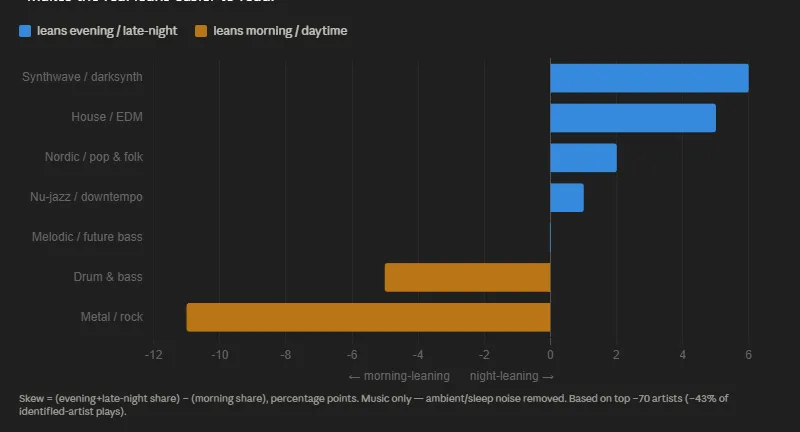
What came back was honest in a way I hadn’t asked for:
- 48,367 plays across 10,804 artists in three years. That’s not a playlist. It’s a behavioural record of my life, accurate to the second.
- A drum & bass act called Venjent turned up out of nowhere this year and already has 1,159 plays in barely six months. I genuinely hadn’t noticed how hard I’d fallen for it. The data noticed.
- My single most-played track isn’t a song. It’s “Brown Noise for Sleep,” at 202 plays - which is what it takes to cover the noise of our house so the baby actually stays asleep. Not quite the personality reveal I was hoping for.
- I peak at 8-9pm every single day, like clockwork - an evening habit I’d never have guessed at if you’d just asked me.
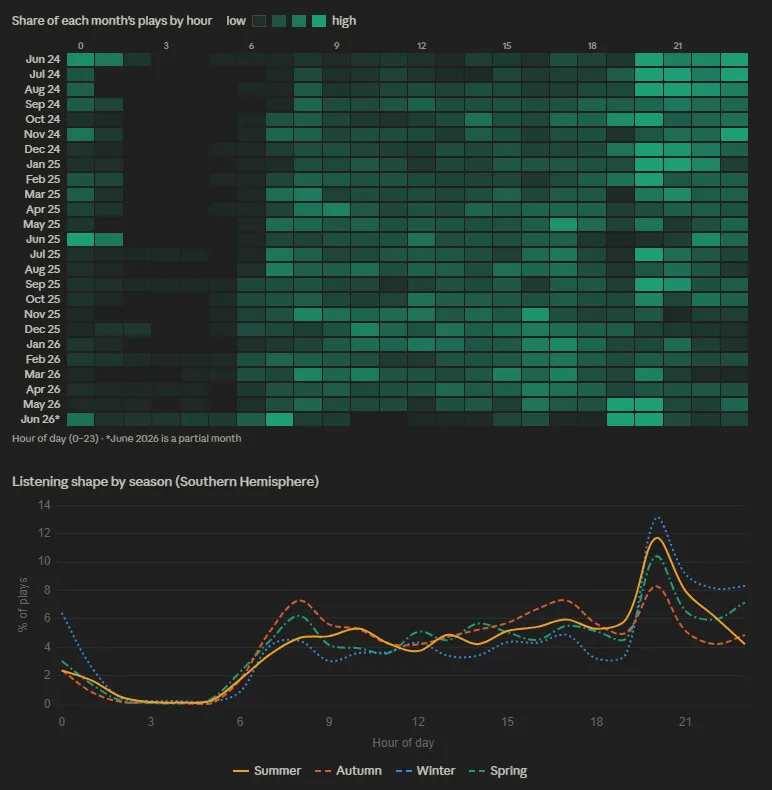
None of that is something I could have told you off the top of my head. Which is the whole point.
One catch worth knowing about
The first draft proudly announced I “discover around 4,900 new artists a year.” A mate called “Bullshait” on it, and he was right. Three-quarters of those “new” artists were played exactly once and never again - autoplay and radio, not discovery. The honest figure is closer to 300-650 a year.
The data didn’t lie. The label did. “New artist” was quietly doing enormous, dishonest heavy lifting, and a number is only ever as good as the definition sitting behind it. Your business has these too - “active customer,” “resolved ticket,” “qualified lead.” Worth knowing what they actually mean before you put one on a slide. Which is the entire reason you want a sceptic in the room.
The part that’s actually about your business
This is why I bothered writing any of this up. Swap “my music history” for almost any business system and the story is word-for-word identical.
You are sitting on exports exactly like my 48MB mess - transaction logs, support tickets, form submissions, CRM activity, years of timesheets. It’s all there, it’s all yours, and most of it has never been properly looked at, because opening it up sounds like a project and nobody has the afternoon spare.
The steps that worked on my playlists are the same ones that work on your data:
- Get it out cleanly - and have a hard think about who you’re trusting before you click “connect account.”
- Hand the mess to AI and just ask - plain questions, the way you’d ask a person. You don’t need to be technical to do this.
- Then keep asking - the value isn’t one report, it’s being able to interrogate the thing whenever something nags at you.
My playlist project took half an hour and told me things about myself I half-knew and half-avoided. The same approach pointed at your sales data or your support queue tends to surface the things you’ve been half-avoiding there too - and those are usually the expensive ones.
So yes, fine, I used AI on my own data and felt clever about it. But the actual lesson isn’t “AI is clever.” It’s that the awkward export sitting unopened in a folder is almost always the most interesting conversation we can have. Bring the messy file. The mess is where the answers are.
Want to know what’s hiding in your own data? That’s most of what I do at Secure Minded. Send me the awkward export nobody’s opened - I promise to be less smug about yours than I was about mine.